
What to Do Immediately After Basement Flooding
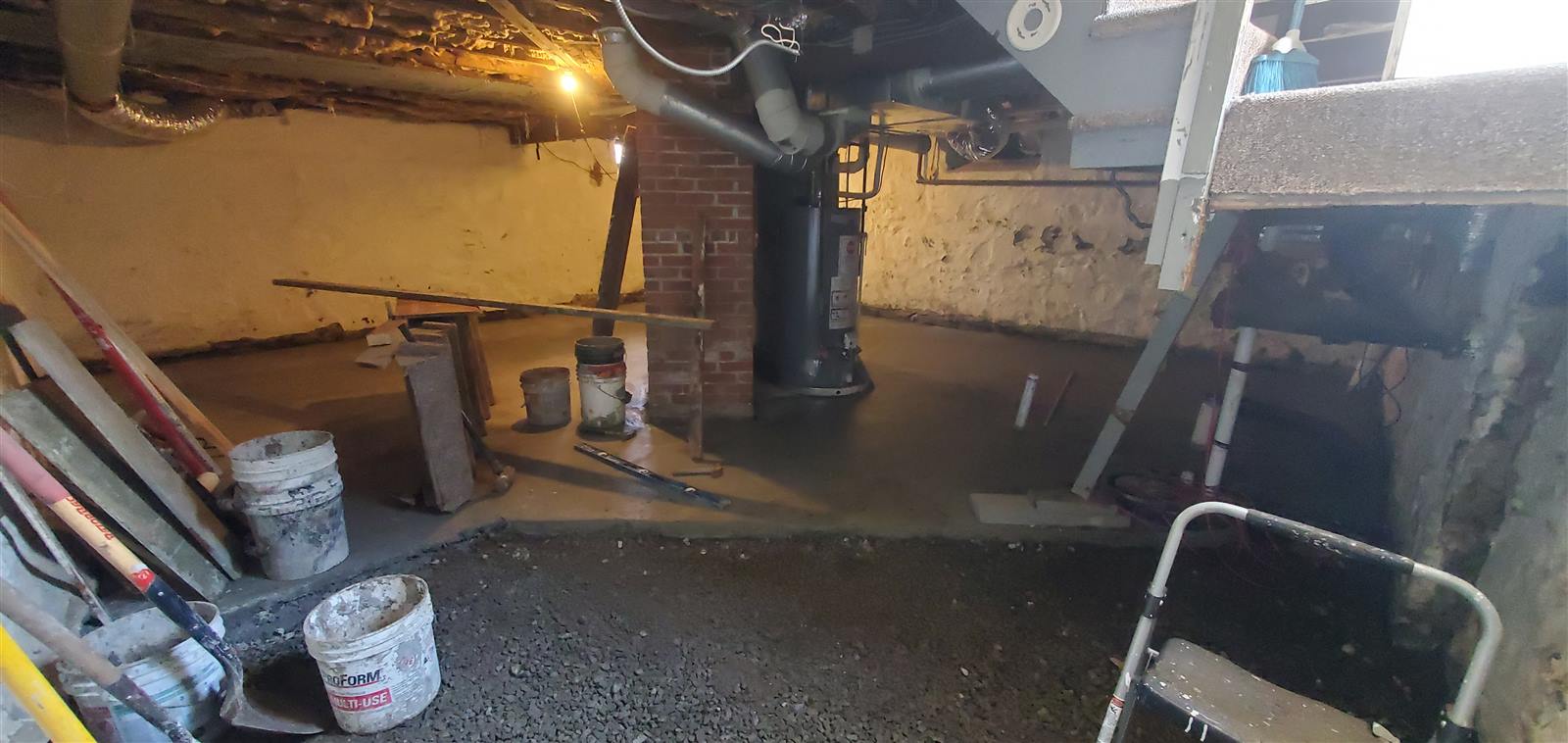
A flooded basement is one of the few jobs where what you do in the first few hours changes what the whole thing costs. Water that is out and drying the same day is a cleanup. The same water left sitting for three days is a demolition. Whether it came from a storm, a sump pump that quit, a burst supply line or a sewer backup, this is the order we walk homeowners through, what the work actually costs once the water is gone, and how to make sure it does not happen again.
The First Hour: Safety Before Anything Else
Standing water and electricity are the combination that hurts people. If there is any chance water has reached outlets, appliances, the furnace or the panel, do not go down there until power to that area is off. If the panel itself is in the flooded area, that is a call to your electrician or the utility — not something to reach for in the dark with wet feet.
Two more things before you go down. If you smell gas, leave the house and call it in from outside. And if the water came from a sewer backup or came in off the street, treat it as contaminated: boots, gloves, no bare skin, and keep kids and pets upstairs. That category of water is not a mop-and-bucket situation.
Photograph Everything Before You Move Anything
This is the step people skip and regret. Before you carry one box up the stairs, document what you are looking at.
- Wide shots of every wall showing the water line, plus a close-up with a tape measure held against the wall so the depth is provable.
- Video. Walk the whole floor slowly, narrate what you are seeing and the date. It takes two minutes and captures things stills miss.
- The mechanicals. Furnace, water heater, washer, dryer, panel. Get the model and serial plates in focus, because replacement values come off those.
- Contents before they move. Photograph the pile before you carry it out, and again at the curb. Do not throw anything away until you have both.
- The source, if you can see it. The window well, the crack, the cove joint, the failed pump, the split hose.
- Receipts for everything, including the fans you rented and the hotel if you had to leave.
Once the water is out and the pile is at the curb, the photos are the only version of the event that still exists. Adjusters work from evidence, and homeowners with good photos routinely do better than homeowners with a good story.
Call Your Insurance Company Early
Call as soon as it is safe. Describe the source honestly, because the source is what determines coverage. Standard homeowner policies commonly handle a burst pipe one way, a sewer or drain backup another way — often only if you carry that specific endorsement — and storm-driven surface flooding a third way, which is frequently excluded entirely without separate flood coverage. Get a claim number, ask what documentation the adjuster will want, and ask directly whether emergency mitigation is covered before you authorize work.
Be honest with yourself about this too: coverage is between you and your insurer, and no contractor controls that decision. What we can do is document the work properly, provide readings and photographs, and meet the adjuster on site.
Get the Water Out: the 24 to 48 Hour Window
Mold can take hold within 24 to 48 hours in a warm, damp basement, and Connecticut basements in summer are warm and damp on a good day. That window drives everything.
Proper extraction is pumping and vacuuming standing water out, removing the materials that are gone, then running air movers and commercial dehumidifiers until moisture meters — not hands, not eyes — say the framing and slab are dry. Surface-dry drywall with a soaked cavity behind it looks finished and is not. The usual honest calls: carpet padding always goes, saturated insulation always goes, drywall gets cut back above the water line, and solid wood and framing can often be dried in place if the drying starts fast enough.
What This Work Costs
| Work | What it covers | Typical cost |
|---|---|---|
| Water extraction and dry-out | Pumping out standing water, removing saturated materials, hauling debris, air movers and dehumidifiers running until meter readings are back to normal. The emergency phase. This is what starts in the first 24 hours. | From $5,000 |
| Interior waterproofing | Managing water once it reaches the foundation: interior perimeter drainage, a sump and pit, sealing and vapor management at the walls. Less disruptive, does not disturb landscaping or paving. | From $15,000 |
| Exterior waterproofing | Keeping water off the foundation in the first place: excavation around the house, membrane at the wall, French drain and pump. The more complete fix. Includes the French drain and pump. | From $30,000 |
| Rebuilding the finished space | Framing, insulation, drywall, flooring, trim, paint, and whatever was in there before. Same range as finishing a basement from scratch. Whole basements run $40,000 to $300,000. | $45 – $200 / sq ft |
If the basement was finished, rebuilding it lands in the same range as finishing one from scratch: $45 per square foot for dry, painted, usable space at the low end, up to $200 per square foot fully built out with cabinets, a bathroom and an egress exit. Whole basements generally run $40,000 to $300,000 depending on what is going back in.
A Realistic Timeline
- First hour. Power off to the affected area, people and pets upstairs, gas checked. Nobody wades into standing water until this is settled.
- Next few hours. Photos and video, then the call to your insurer. Get a claim number.
- First 24 hours. Extraction starts. Standing water out, saturated contents out, air movers and dehumidifiers set.
- 24 to 48 hours. The mold window. Porous materials saturated past this point generally come out rather than get dried.
- Days 3 to 7. Active drying continues and gets logged. Meters decide when it is dry, not the calendar and not how it feels to the touch.
- Once it reads dry. Fix the cause. Drainage, a sump, waterproofing, grading, gutters, a window well — whatever let the water in.
- Then rebuild. 4 to 12+ weeks on site depending on how much of the basement was finished and what is going back in.
The step people are tempted to skip is the one between drying and rebuilding. Putting the same finished basement back over the same unfixed problem just resets the clock until the next storm.
Why It Flooded
Rebuilding without answering this is the most expensive mistake in the whole process. Nine times out of ten it is one of these:
- The sump pump failed, or the power went out in the same storm that brought the water, which is the most common version of this story. A pump with no battery backup is a pump that is offline exactly when you need it.
- The discharge line was blocked or frozen, so the pump ran and ran and pushed the water nowhere.
- Gutters and downspouts are dumping at the foundation. A clogged gutter puts hundreds of gallons against the wall in one storm.
- The grade pitches toward the house. Ground settles over decades and nobody notices until it rains hard.
- A window well with no drain, or no cover, filling up and coming through the window.
- Hydrostatic pressure. The water table comes up and pushes through the cove joint where the wall meets the slab, or straight up through the floor. Nothing is broken; the ground is just full.
- A sewer or drain backup, which is a plumbing problem, not a weather problem, and needs a camera in the line rather than a pump.
- A burst supply line or a failed water heater. Not weather at all, and it can happen on a clear day.
Interior or Exterior Waterproofing
Interior work manages water after it has already reached the foundation. It is less disruptive, it does not tear up your landscaping or driveway, it starts at $15,000, and for a lot of houses it is the right answer.
Exterior work stops the water at the wall before it gets in. It means excavating around the foundation, sealing or membraning the wall, and installing a French drain and a pump. It starts at $30,000, it takes longer, and it disturbs everything planted or paved against the house — but it deals with the problem at the source.
Which one is right depends on where water actually enters, how the ground is graded, how much access there is around the house, and what is already built against the foundation. Anyone who tells you which one you need before walking the outside of your house in the rain is selling, not diagnosing.
Tips From the Jobsite
- Put a battery backup on the sump pump. The storm that floods you is the same storm that takes your power out. This is the single highest-value thing on this list.
- Test the pump every few months. Pour five gallons into the pit and watch it kick on, run, and shut off. Also check that the discharge is actually flowing out where you think it is.
- Put a cheap water alarm on the slab next to the pit and another by the water heater. They cost almost nothing and they buy you hours.
- Get everything off the floor. Shelving on legs, plastic bins with lids, no cardboard on concrete. Cardboard wicks water and grows mold faster than almost anything else down there.
- Extend the downspouts well clear of the foundation and clean the gutters every fall. It is the cheapest waterproofing there is.
- Photograph your basement now, while it is dry. Wide shots of every wall and everything stored down there. A dated “before” set makes a future claim dramatically easier.
- Label the main water shutoff and the basement breakers so anyone in the house can find them in the dark.
- Keep the policy and declarations page somewhere that is not the basement, and a photo of both on your phone.
- Never run a gas generator or a gas pump in an enclosed basement. Carbon monoxide kills people during storm cleanups every year.
- Do not lay finished flooring back down until the slab reads dry. Trapping moisture under new vinyl or tile undoes the whole dry-out.
What to Look For Before You Hire Anyone
Water damage attracts people who show up uninvited after a storm. Before you sign anything, even under pressure:
- Check the license. Home improvement contractors in Connecticut must be registered with the Department of Consumer Protection. Ask for the number and look it up. Ours is CT HIC #0660720.
- Ask for a certificate of insurance covering general liability and workers compensation, sent to you directly by the insurer.
- Ask for moisture readings in writing, before and after, plus a drying log. If nobody is taking readings, nobody knows when the job is done.
- Insist on an itemized scope, separating emergency mitigation, demolition, the root-cause fix and the rebuild. Those are four different budgets and they should be four different sections.
- Be careful with anyone who knocks on your door after a storm, wants a large deposit on the spot, or pushes you to sign a work authorization or assignment of benefits before you have read it. Slow down. Nothing gets worse in the twenty minutes it takes to read a page.
- Ask whether they will meet the adjuster on site and provide photographs and readings to support the claim.
- Ask what happens if the walls still read wet at the recheck — whether more drying is included or billed as an extra.
- Ask who is fixing the cause, not just the damage. A contractor who only wants the rebuild is leaving you exposed to the next storm.
- Ask to see photos of their own past water damage jobs, including demo and drying stages, not just finished rooms. Ours are on our projects page.
Common Questions
How much does it cost to fix a flooded basement in Connecticut?
Water extraction and dry-out starts at $5,000, and that is the part that happens immediately. Fixing the cause is separate: interior waterproofing starts at $15,000 and exterior waterproofing, which includes a French drain and a pump, starts at $30,000. Rebuilding a finished basement afterwards runs $45 to $200 per square foot.
How fast does mold grow after a basement floods?
Mold can take hold within 24 to 48 hours in a warm, damp basement. That window is the whole reason extraction and drying start immediately, and it is why porous materials that have been saturated longer than that — carpet padding, insulation, soaked drywall — usually have to come out rather than be dried in place.
Does homeowners insurance cover a flooded basement?
It depends entirely on where the water came from. Standard policies commonly treat a burst pipe differently from a sewer backup, and differently again from storm-driven surface flooding, which is frequently excluded unless you carry separate flood coverage. Call your insurer early, describe the source honestly and ask what your policy covers.
Should I waterproof from the inside or the outside?
Interior waterproofing manages water after it reaches the wall and starts at $15,000. Exterior waterproofing keeps water off the foundation in the first place, includes a French drain and a pump, and starts at $30,000. Which one is right depends on where the water gets in, how the ground is graded, and what access there is around the house.
Can I dry the basement out myself with a shop vac and some fans?
For a small, clean-water spill caught in the first hour, sometimes. For anything that soaked drywall, insulation or carpet padding, household fans dry the surface while the wall cavity stays wet, and that is exactly how mold starts somewhere you cannot see it.
How long before I can rebuild?
Not until moisture meter readings on the framing and the slab are back to normal, which usually takes several days of active drying and sometimes longer. Rebuilding the finished space then runs 4 to 12+ weeks depending on how much of the basement was finished and what is going back in.
Get a Real Number for Your Basement
Every flooded basement is different: where the water came from, how long it sat, what was finished, and what has to change so it does not happen again. The only way to get an accurate figure is to have someone stand in the space, take readings, look at the outside of the house, and price the actual work. That walkthrough is free.
Keep Reading
Dealing With Basement Flooding Right Now?
We handle water damage repair and coordinate directly with your insurance adjuster on the claim.
Get Help With Your Claim